The Leopard
Pranav Iyer · Sept. 29, 2026, 6 p.m.
A few days ago now, I finished The Leopard (Il Gattopardo), by Giuseppe Tomasi di Lampedusa. I picked it up as my partner and I were traveling to Sicily, and it seemed like an appropriate choice. At the end, I was very impressed by the book—I liked it a lot. I ended up with quite a few thoughts on the book, so I've tried to organize them a bit by theme below.
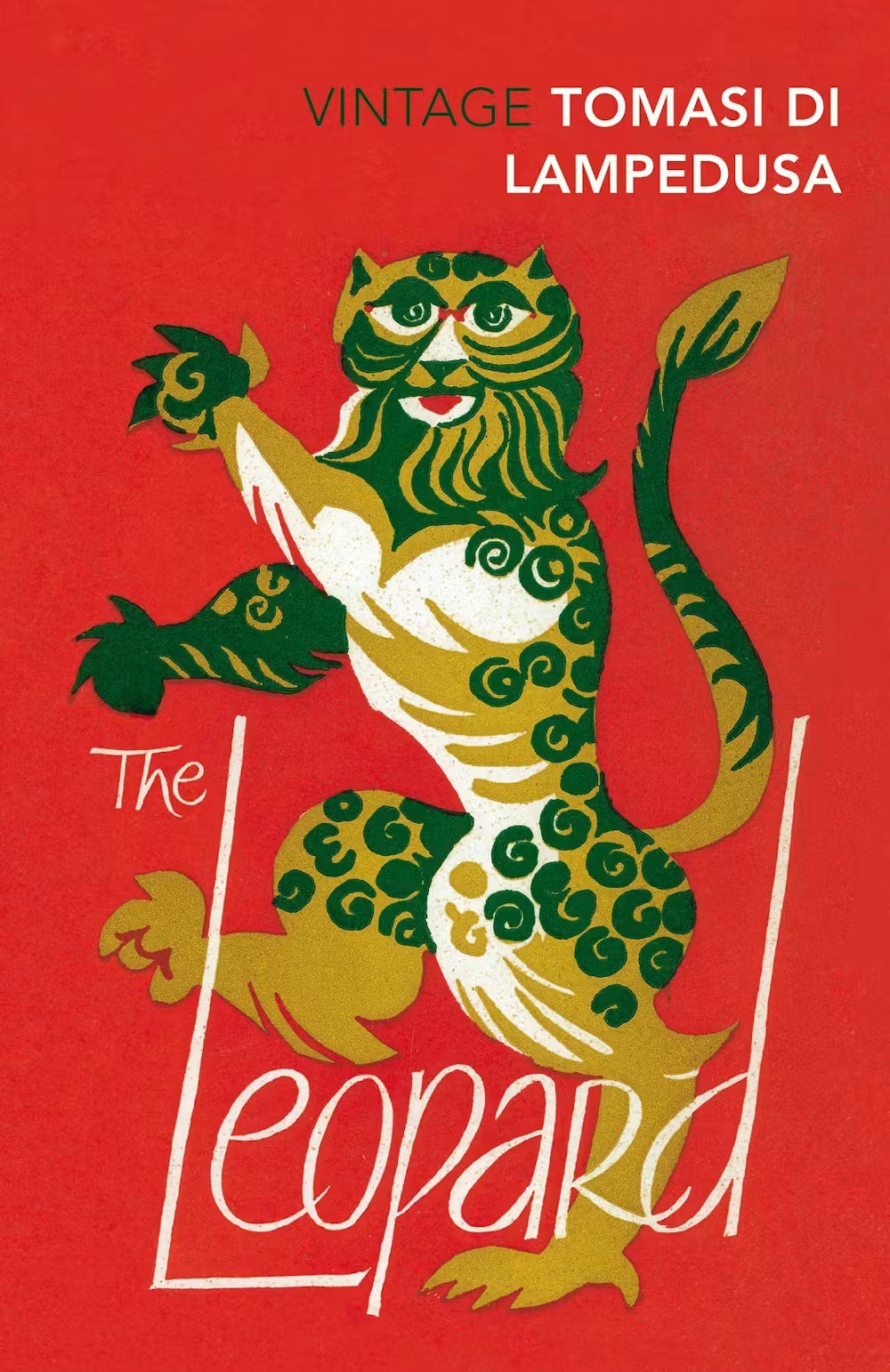
The cover of my edition of The Leopard.
Sicilian history
The first and most clear area of interest from the book was a new perspective for me on Sicilian and Italian history in the 19th century. I did not know much about Risorgimento before the trip and the book, and I think I came away with a much more informed perspective on this period of history. I am as always shocked at how much 19th-century Europe is so completely full of contradictions, and it seems this is extremely evident in Sicily—with a deeply entrenched noble class that is really struggling to come to terms with the democratizing forces of the time.
An idea that stuck with me, from Don Fabrizio:
In Sicily it doesn't matter about doing things well or badly; the sin which we Sicilians never forgive is simply that of 'doing' at all.
and later:
Sleep, [...] sleep, that is what Sicilians want, and they will always hate anyone who tries to wake them, even in order to bring them the most wonderful of gifts
The Prince says these things while talking to the Piemontese Secretary who asks him to be a Senator in the new Italy—and Lampedusa uses the occasion to highlight the gap between the northern and southern Italian perspectives.
Not being Sicilian myself, I had a very hard time believing this characterization of the island—I'm not inclined to believe any population can be characterized as inert, unwilling to change, or lazy, as an aspect of their character. It really rubs me the wrong way, especially knowing what I know about Lampedusa's highly privileged background.
And yet, I think if you asked me whether similar statements apply to the parts of the US that I grew up in (especially with regards to politics), I might be very much inclined to agree! So perhaps the lesson is not that Sicilians are essentially resistant to change, but that everyone tends to find their own home more resistant to change than the outside world.
Style
On to the book's own merits: I loved the style. It is fairly conservatively written, with no crazy stylistic innovations. Definitely reads like the work of an aristocrat who decided later in life that he could also write a book. However, it was extremely well-written throughout—the plot and pacing were carefully considered, I found the descriptions evocative but not overloaded, and the characters seemed rounded and human.
It's also the kind of book that is just plain fun to read—it's full of witty asides and thoughtful remarks from the author, that mean that on every page there is something worth thinking about. I think it's one of the most important aspects of a book that I want to read for fun, that it makes the reading process itself much more rewarding if you constantly have interesting little thoughts based on what you read.
Pacing
And then the other main thing that stuck out was the rhythm of the book. I was struck by the construction and how well it worked for me: eight chapters which cover nearly fifty years, but each one zooms in on a moment and tells it in an in-depth style, always focused on the inner lives of the characters. My two favorite chapters were I. Introduction to the Prince and V. Father Pirrone Pays a Visit, and both I think are excellent examples of this. The Father Pirrone chapter I liked in particular as he seems an incidental character in the previous segments, and yet here it becomes clear that he represents a very important part of the story that Lampedusa wants to tell.
To me, it's a mark of how successful the book is is that with its eight chapters, each covering a small moment in time, it manages to tell such a complete, wide-ranging story, and seem to touch on nearly all aspects of life.
According to Wikipedia, his original plan for the book was all to be set on the first day, like Joyce's Ulysses—though I haven't read Ulysses, I can get the sense that he was inspired by it, in the slow pace and heavy focus on the internal world of the Prince.
The Prince
Of the characters in the book, the most interesting is of course the Prince himself. He is the most difficult archetype to pull off convincingly, and here I think Lampedusa manages brilliantly: he is simultaneously immoral, harsh, calculating while always seeming to carry a grace, nobility, and genuine melancholy. He seems quick to anger, and yet also shows himself quick to forgive (for example, Father Pirrone in the first chapter). Lampedusa completely succeeds in capturing his inner world, as both a human, and a representation of the noble class of that era.
The other characters, while much smaller, I still found quite interesting—especially in their revealing and more memorable moments: Angelica discovering her knack for art criticism simply by making unfavorable comparisons, Father Pirrone giving a long speech about the nobility to his fast asleep companion. All of this serves to give the book a really wonderful texture that draws you in to the world Lampedusa created.
Favorite passage
Of course, I have to choose my favorite passage from the book to finish. I'll choose the Prince's defense of his class to Father Pirrone in the first chapter:
We're not blind, dear Father, we're just human beings. We live in a changing reality to which we try to adapt ourselves like seaweed bending under the pressure of water. [...] Any palliative which may give us another hundred years of life is like eternity to us. [...] [B]eyond what we can hope to stroke with these hands of ours we have no obligations.
I find it very nicely written, and somehow very emblematic of the reflections of the book on the death of the noble class of that time.
powered by
 ·
made with
-ly
·
made with
-ly
·
made with
-ly